 LUMP Depot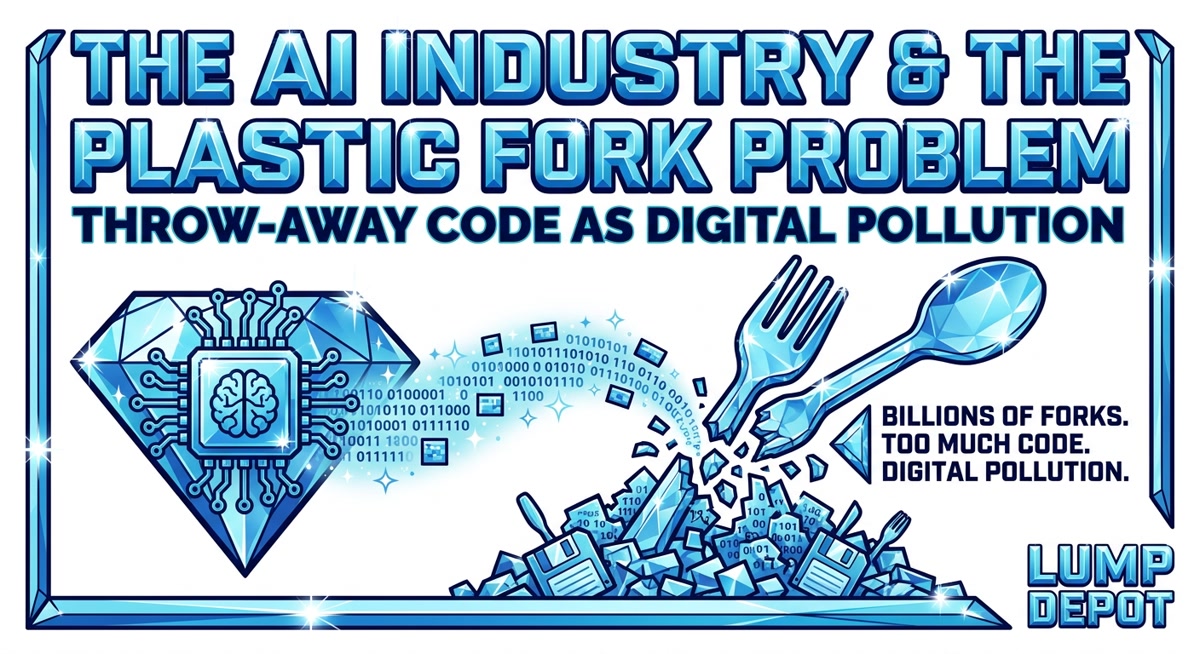
I made a thing this week that I've started calling vibeslop. It's a screensaver, technically, the kind that serves no purpose except to look nice when I walk away from my desk. It cost me about $400 in fable tokens off my monthly subscription, and it never would have existed otherwise. Nobody was going to pay me to build it. I was never going to sit down and write it by hand. But the tokens were already paid for, so I let the agent cook, and now I have a vibeslop.
That's the moment it clicked for me. The future of our industry is in the garbage can.
The plastic fork problem
Plastic forks are a miracle if you think about it for two seconds. Cheap, disposable, good enough, gone in five minutes. Nobody agonizes over a plastic fork. You use it once and throw it away, and that's the entire point. It exists because it became almost free to make one.
AI did the same thing to code. It made throw-away code almost free. My vibeslop is a plastic fork. It was cheap to produce, it does the job, and I will not lose a single minute of sleep when I delete it. A year ago that effort would have been a real decision. Now it's a token balance and a shrug.
And just like the fork, the problem isn't the one fork. It's the billion forks.
There is going to be too much code
We are about to drown in code the way the rivers are drowning in plastic. There probably already is too much, honestly. Every prompt is another fork, every agent run is another handful tossed in the water, and the cost of making more keeps dropping.
When a thing is cheap enough, people stop being careful with it. They don't recycle a plastic fork and they won't curate a throw-away repo either. It piles up. It flows downstream. It ends up somewhere, and that somewhere is everyone's problem instead of the maker's problem.
The volume is the pollution. Not any single piece of it.
Styrofoam instead of concrete
Here's the part that actually worries me. When everybody can roll their own everything, nobody specializes in anything.
You used to need an expert to build a thing, and that expert was accountable for it. There was a person who understood the system, who could be called when it broke, who carried the thing in their head. That's concrete. It's heavy and slow to pour, but it holds.
Throw-away code doesn't work like that. When the agent built it, who owns it? You half-understand it. The model that wrote it has already moved on to the next version of itself. There's no expert because nobody had to become one. There's no accountability because nobody really made the decision, the tokens did.
So the systems get lighter and faster to produce and they hold a lot less weight. Styrofoam instead of concrete. Looks like a building. Squishes when you lean on it.
GitHub as a digital landfill
And then there's where all of it goes to live. Picture the next few years of this. Mountains of generated repos, half-finished, near-duplicate, abandoned the moment the prompt that made them stopped being interesting. The search results get worse. The signal gets buried. The good stuff sits next to ten thousand plastic forks and you can't tell which is which until you pick one up.
GitHub turns into a digital landfill, and not because anybody's a villain. Just because making garbage got cheaper than not making it.
Are we ready for this?
The plastic industry never really answered for the rivers. They made the cheap thing, everybody loved the cheap thing, and the cleanup became somebody else's problem decades later. I don't think our industry has a better plan. We're producing throw-away faster than we've ever produced anything, and we haven't even started the conversation about what to do with the pile.
I'm not saying don't make the vibeslop. I made the vibeslop. I'm saying we should probably notice what we're standing in before it's up to our knees.
tl;dr: AI made code as cheap and disposable as a plastic fork. The problem isn't any one throw-away project, it's the billion of them. Less expertise, less accountability, lighter systems, and a GitHub that's filling up like a landfill. Worth asking if we're ready before the river's already choked.